
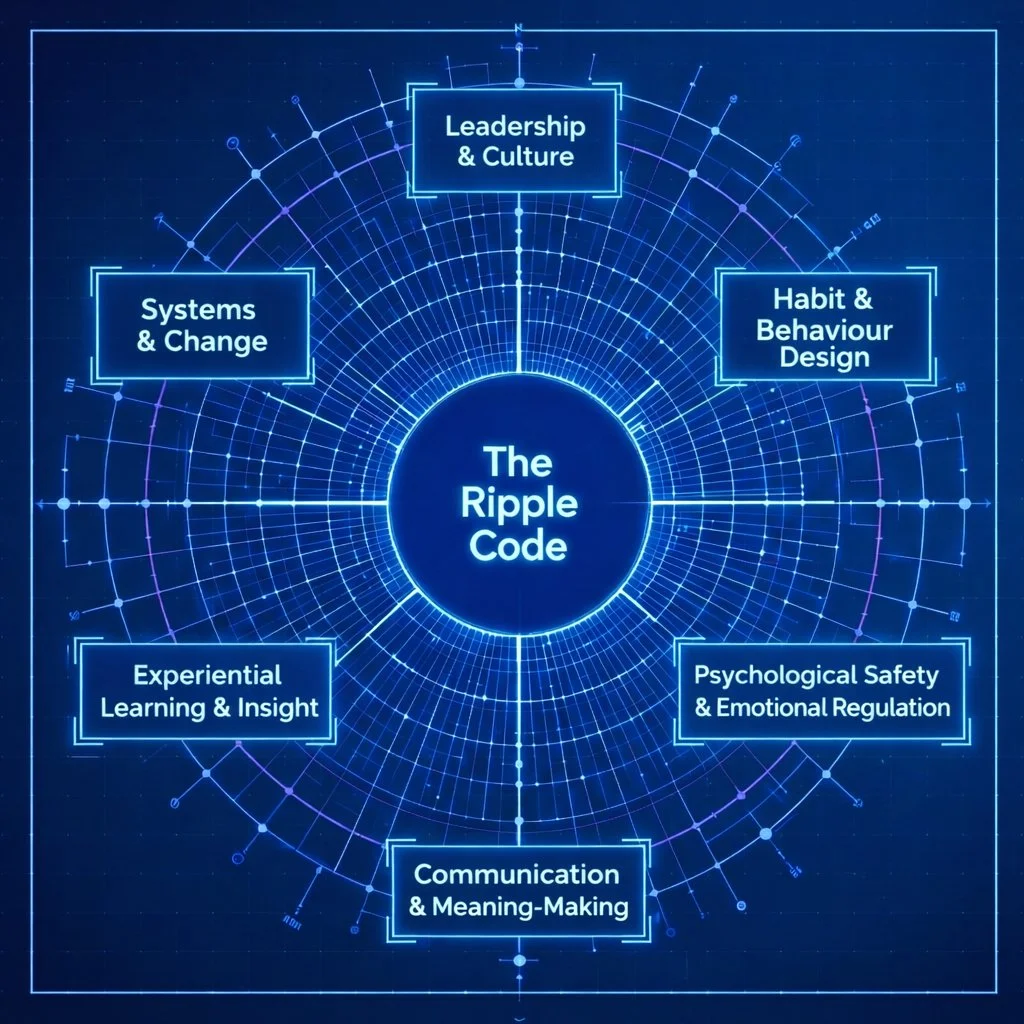
The Ripple Code
The quiet engine behind how behaviour changes under pressure
Most incidents or cultural breakdowns don’t happen because people don’t know what to do.
They happen because, in the moment, something gets in the way whether that’s pressure, fatigue, hierarchy, uncertainty, emotion, or the fear of getting it wrong.
The Ripple Code is our design discipline for those moments.
It blends behavioural science, psychology, human factors and lived workplace insight to create learning experiences that don’t just inform people, they change what people do when it matters most.
It’s not something people memorise.
It’s something they feel.

Why the Ripple Code exists
Ripple’s work sits inside high-risk, high-pressure environments such as energy, utilities, construction, transport and engineering.
These are places where decisions are fast, conditions shift quickly, and moments of hesitation can have real consequences.
Policies help.
Training helps.
But behaviour under pressure is what protects people.
The Ripple Code exists to answer one essential question:
What helps people do the right thing, when doing nothing would be easier?
It isn’t a framework for show.
It isn’t a checklist.
It’s the thinking that shapes every diagnostic, scenario, conversation and behavioural shift we design.

What the Ripple Code is (and isn’t)
The Ripple Code is:
A human-centred behavioural design approach
Grounded in psychology, human factors and social science
Built for real working environments, not classrooms
Focused on the pressured moments where behaviour actually breaks down
Proven through immersive, emotionally realistic practice
The Ripple Code is not:
A model people must learn
A theoretical framework delivered as content
A set of slides or principles
Something we “teach” - it’s something we design with
Clients often say they can feel the Ripple Code before they can explain it because it shapes everything underneath the experience.
The behavioural forces of the Ripple Code
The credible science that shapes how we design behaviour change
Every Ripple intervention is built using six Behavioural Forces, the evidence-based influences that determine how people think, feel and act under pressure.
They don’t appear as models in the session.
They shape how the session works.
-

Leadership & Culture Force
How leadership tone, decisions and everyday signals shape trust, permission and behavioural norms.
Grounded in leadership science, culture theory and safety-climate research.
-

Habit & Behaviour Design Force
How habits form under stress, and how micro-behaviours shift in pressured environments.
Grounded in behaviour change models (including COM-B), habit formation and implementation intentions.
-

Psychological Safety & Emotional Regulation Force
How people assess interpersonal risk and manage emotion in difficult moments.
Grounded in psychological safety and emotional intelligence research.
-

Communication & Meaning-Making Force
How clarity, framing, questions and trust shape high-stakes conversations.
Grounded in communication science and risk-perception research.
-

Experiential Learning & Insight Force
How people learn through doing, reflecting and trying again.
Grounded in experiential and transformative learning, and participatory drama methodologies.
-

Systems & Change Force
How organisational pressures, processes and signals shape front-line decisions.
Grounded in systems thinking, safety science and organisational change research.
Together, these Forces ensure our work isn’t just engaging - it’s scientifically sound, operationally relevant and behaviourally effective.
The Three lenses of the Ripple Code
How we ensure behaviour change doesn’t sit with individuals alone
Every Ripple experience is designed through three connected lenses, ensuring behaviour change is supported at every level.
-

Individual
Confidence, emotional regulation, judgement and capability in the moment.
-
Team
Norms, expectations, trust and the response people receive when they speak or act.
-
System
Leadership signals, resource pressures, incentives and cultural patterns.
The Ripple Code ensures we never ask people to change when the system won’t support them.
Why the Ripple Code works
Because it respects reality.
People don’t change because they’re told to.
They change when the design:
Feels recognisable
Makes the invisible visible
Allows them to try, fail and try again
Helps them understand the impact of their actions
Creates the psychological safety to practise new behaviours
The Ripple Code turns learning into lived experience, the kind that holds when pressure hits.
What the Ripple Code enables
When applied well, organisations see:
Earlier intervention and healthier conversations
More consistent leadership under pressure
Reduced reliance on rules and enforcement
Stronger accountability across teams
Safer, more human workplace cultures
Not because people learned a model but because the conditions for better behaviour were deliberately created.
In simple terms
The Ripple Code helps organisations move from:
Knowing → Doing
Policy → Practice
Awareness → Action
It is the quiet engine behind every Ripple experience - and the reason our work changes what people do, not just what they know.
Trusted by















Get started now